

Work hard to make an impact. Stress out because you’re missing out on life. Slow down to enjoy life. Stress out because you are not making the impact you want. Repeat.
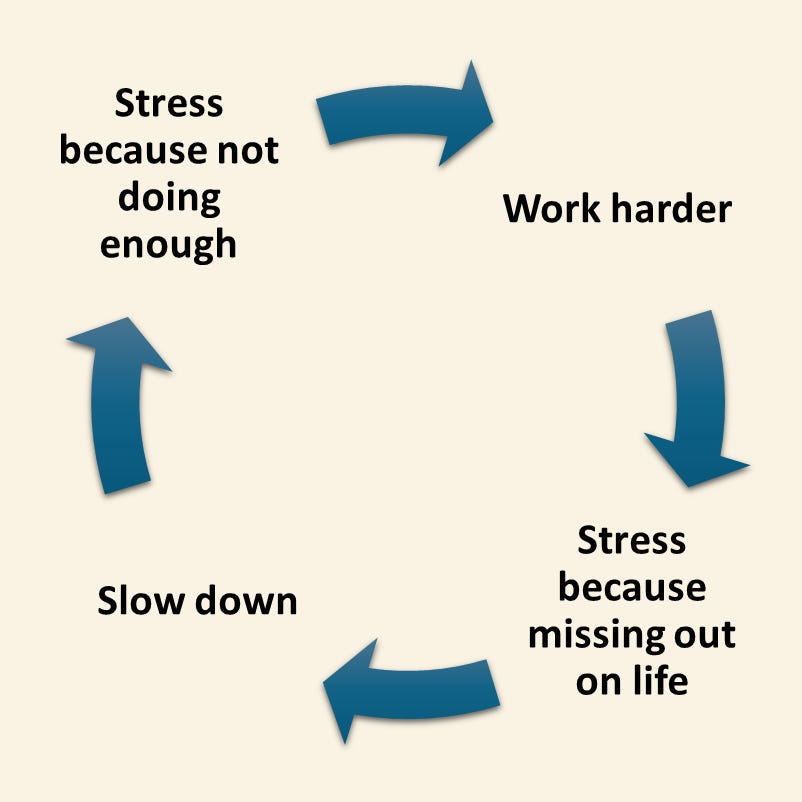
This cycle describes my last… (ehem) many years surprisingly well. And judging by the nodding heads whenever I’ve shared it with others, I suspect it’s a wheel many more people recognize themselves in. I don’t want to say they are trapped in, because in most cases this wheel is the result of personal choices: we are not necessarily trapped in any one single stage; rather, we go in circles around it, and trying not to fall sick while spinning.
I won’t pretend I have a magic solution for how to steer or stop this wheel – not for myself, and therefore even less so for you reading this article. Tons of ink has been poured already on work-life balance and work-life harmony (see from 1:30 if you’re unfamiliar with this concept). Yes, I’m aware that virtue stands in the middle, but that is easier said than lived: “working hard” and “enjoying life” seem to drift apart in the busy-ness of everyday life, and aiming for a theoretical middle point may deliver neither the enjoyment nor the impact you’re after. I’m also skeptical of claims of the type “I love my work, therefore I’m already enjoying life”: you can absolutely love your work, but that does not magically turn 24-hour days into 48-hour ones so that you can also spend abundant time with family, exercise five days a week, read widely, nurture friendships, travel, and master that semi-abandoned hobby of yours – all of which I associate with enjoying life. I also won’t moralize about whether this is a healthy cycle: it almost certainly isn’t, and I wish I didn’t think about it as much as I do. But it exists, and rather than ignore it, the best we can do is try to understand it.
What I’m most interested in is the why’s of the cycle: why the wheel keeps on turning and what are the mindsets that push us from one position to the next. I believe it all starts from one’s life goals (implicit or explicit) and from there boil down to a small set of fundamental motivation drivers: enjoyment, wealth, transcendence, and responsibility.
Let’s tackle them one at a time.
Life goals
Our lives are governed by a strikingly large number of goals. Some might be explicitly stated, even publicly communicated; others are so implicit that we may not even realize they exist. Yet all of them shape how we allocate our most finite resource: time.
Work-related goals tend to be visible and explicit: reach X in sales, deliver Y in profit, raise customer satisfaction to Z, launch N projects. Work goals are often defined annually and reviewed quarterly or monthly. Personal goals, by contrast, tend to remain implicit. We all have them, but rarely write them down or even notice them unless we fail badly in reaching them. They range from the most mundane stuff (get the kids to school on time, pay the mortgage) to the aspirational kind (exercise more, lose weight, read more).
However, rarely do personal goals have a time horizon greater than a year. If I asked about what goals people have for their lives (not for the next year), I suspect many would hesitate or improvise something broad on the spot e.g., “be happy”, “be healthy”, or “have a loving family”. The irony is that without conscious effort, our lives end up governed by a series of goals with very short lifespans and which we might even never have articulated. We want to be in control of our lives when we are not necessarily stating or managing our life goals, and that mismatch breeds frustration.
Instead, it is much better to define your life goals upfront, and do so crisply manner. For some, their goal is to enjoy life. For others it might be to accumulate wealth. For some it might be to leave a legacy (transcendence). And some may walk life “doing the right thing”.
Whatever your case, your goals (explicit or implicit) should be a reminder of the direction in which you want to lead your life, and support you in finding your right spot in the work harder vs. enjoy life cycle.
Motivation driver #1: Enjoyment
In philosophy, Hedonism (from the Greek word ἡδονή, read hēdonḗ, meaning pleasure) supports “the belief that the most important thing in life is to enjoy yourself”1. Hedonists place pleasure at the center; for them, pleasure is the highest good and goal in life, and pain is the ultimate evil. In its simplest form, a good life is one that maximizes pleasure and minimizes suffering. Epicureans, more restrained, argue that the highest pleasure is not intense enjoyment, but the absence of pain and mental disturbance (ataraxy). Same word — pleasure — and radically different interpretations.
But this isn’t a philosophy lecture: the point is simply that the role of enjoyment or pleasure as a life goal is an old question, unresolved, and deeply personal. There’s not a right or wrong answer: you should go for whatever most resonates with you. In my case, there are two opposing forces: one pushes me away from enjoying life, and the other back again into it.
Pushing me away from enjoying life is the tension between enjoyment today and enjoyment tomorrow. You may recall the fable of The Ant and the Grasshopper from your childhood. Or maybe you have heard about the marshmallow experiment run by (at the time) Stanford student Walter Mischel in 1970. In this experiment, children were handed a marshmallow and offered the choice to either eat it (and they’d only have that one treat), or wait for 15 min until the adult returned and would give them a second marshmallow. Many chose the smaller immediate reward instead of the larger delayed one. In later studies, the researchers found that children who were able to defer gratification i.e., wait and get a greater reward, tended to do better in life. I have a tendency to defer gratification (or “enjoyment today”) in favor of a higher reward tomorrow. However, such mentality comes as a cost. No less than 30 years ago, a high school teacher reminded us that “living in the past causes depression; living in the future causes anxiety”. The sentence did not offer a so what, but one would conclude that his recommendation was to “live in the present” (i.e., Carpe Diem), prioritizing enjoyment in present time through moments of pleasure like laughter with our family, kids, or friends, so that by the time we’re old our life journey will have been worth it.
Pushing me back into enjoying life is the realization that good relationships keep us happier and healthier. That’s actually the conclusion from the Harvard Study of Adult Development, which I already mentioned here and for which you can watch a summary in this video. As I already mentioned back then, relationships take time and effort, which means that, unless you invest in them today you won’t enjoy them tomorrow. It will be harder to nurture those long-term personal relationships (which will usually happen outside of work) if you’re permanently in a work hard mode.
Motivation driver #2: Wealth
Wealth as a motivator is not necessarily about being rich: in this context it’s about having one’s needs and desires covered, at whatever level one defines as enough. For some, that means paying debts and achieving basic financial stability. For others, a comfortable lifestyle e.g., a nice house and car, good education for your children, or a fair dose of leisure. For others still, maximizing income to preserve optionality. For a few, to accumulate assets without a clear endpoint.
In all cases, this is closest to “working for money”.
I tend to see this as a constraining motivator, which adds obligations and weight onto our shoulders. It will generally push you to the work harder zone of the cycle, and in an extreme case put you into a fast-spinning rat race. Beyond a certain threshold, money rarely liberates. It mostly locks you into systems you now have to sustain (see my earlier post, “When assets become liabilities”).
So the question is not whether wealth and financial security matter — they do — but how central they are to your life goals, and when “enough” yields to “more”, to the point that it makes you lose your balance between working hard and enjoying life.
Motivation driver #3: Transcendence
Transcending is defined as rising above or going beyond the limits, but in the context of this post, I prefer to define it as having an impact in the world, which outlives you. As a life goal, I associate transcendence to achieving something that is bigger than you, and the impact of which lasts after you’re gone. It is not about reaching fame: cemeteries are filled with people who were famous in life but were also soon forgotten after their death. Unlike wealth, I see transcendence as a positive motivator: although it also adds weight to your shoulders, the sense of purpose makes the weight more bearable.
In the context of this post, the question is not whether you want to transcend as a life goal, but how: if by doing, or by being.
You can transcend by doing, building something meaningful that outlives you e.g., a work of art, a book, music, or a sustainable business. Transcending by doing pushes you towards the work harder zone, as you’ll need to perfect your skills and overcome whatever difficulties lie between you and that transcendent work.
But you can also transcend by being: creating a lasting, emotional, intangible impact on others e.g., learnings, memories, lessons, or moments that others close to you will cherish when you’re gone. If you’ve seen Disney’s movie “Coco”, you know exactly what I mean. Although that impact builds on all the experiences you have accumulated over time (including the ones from work), transcending by being does not push you (as much) towards the work harder zone of the cycle, as those lasting memories tend to live among your close personal relationships, rather than work-related ones.
Motivation driver #4: Responsibility
Responsibility is about doing what needs to be done, not because it is enjoyable, profitable, or meaningful, but because it’s required or expected from you. Family duties, professional responsibilities, social expectations… all different flavors of this same concept.
Responsibility is a noble principle: it comes with commitment, reliability, and care for others. And precisely because of that it can become a particularly sticky motivator: you can morally question the pursuit of pleasure or wealth, and can lose faith in transcendence, but it’s hard to challenge the goodness of being responsible.
However, it can also become a dominant life motivator almost by stealth. And when it does, it often makes you act based on what you “owe” (to people or to systems you are part of) rather than based on what you “want”. Without a deeper purpose, responsibility pushes you towards the work harder part of the cycle, its weight accumulates, and (in a worst case) leads to burnout. The question, therefore, is not whether responsibility should guide your life, but whose expectations you are being responsible to, and whether they are aligned with the life you want to lead.
Concluding
The motivation drivers above are not mutually exclusive. They may also change over time – I expect many people are motivated by enjoyment when young, wealth in their middle age, and transcendence in their later part of their professional life.
Coming back to the wheel I started with, it is probably the tension and the shifting balance among those forces that keeps us spinning between the work harder and the enjoy life positions. And maybe that’s the point. Perhaps the paradox is that, while many of us want to stop or balance the wheel, it only works when it is moving, like satellites in orbit: slow them down and they fall; speed them up too much and they escape into space. Have them spin at the right speed, and they’ll remain where they’re meant to be, fulfilling their mission.
Source: Cambridge Dictionary, https://dictionary.cambridge.org/es/diccionario/ingles-espanol/hedonism
Every sentence resonates with me. Thanks for sharing, Alfonso!
The famous marshmallow study was questioned later and found to be not as predictive:
"The Watts study findings support a common criticism of the marshmallow test: that waiting out temptation for a later reward is largely a middle or upper class behavior. If you come from a place of shortages and broken promises, eating the treat in front of you now might be the better bet than trusting there will be more later".
https://anderson-review.ucla.edu/new-study-disavows-marshmallow-tests-predictive-powers/